

Summary
The JS320 is redesigned for more accurate low-current measurements, with improved offset stability, Enwavify™ v2 range-change technology, and cleaner time-domain response for modern embedded systems.
Introduction
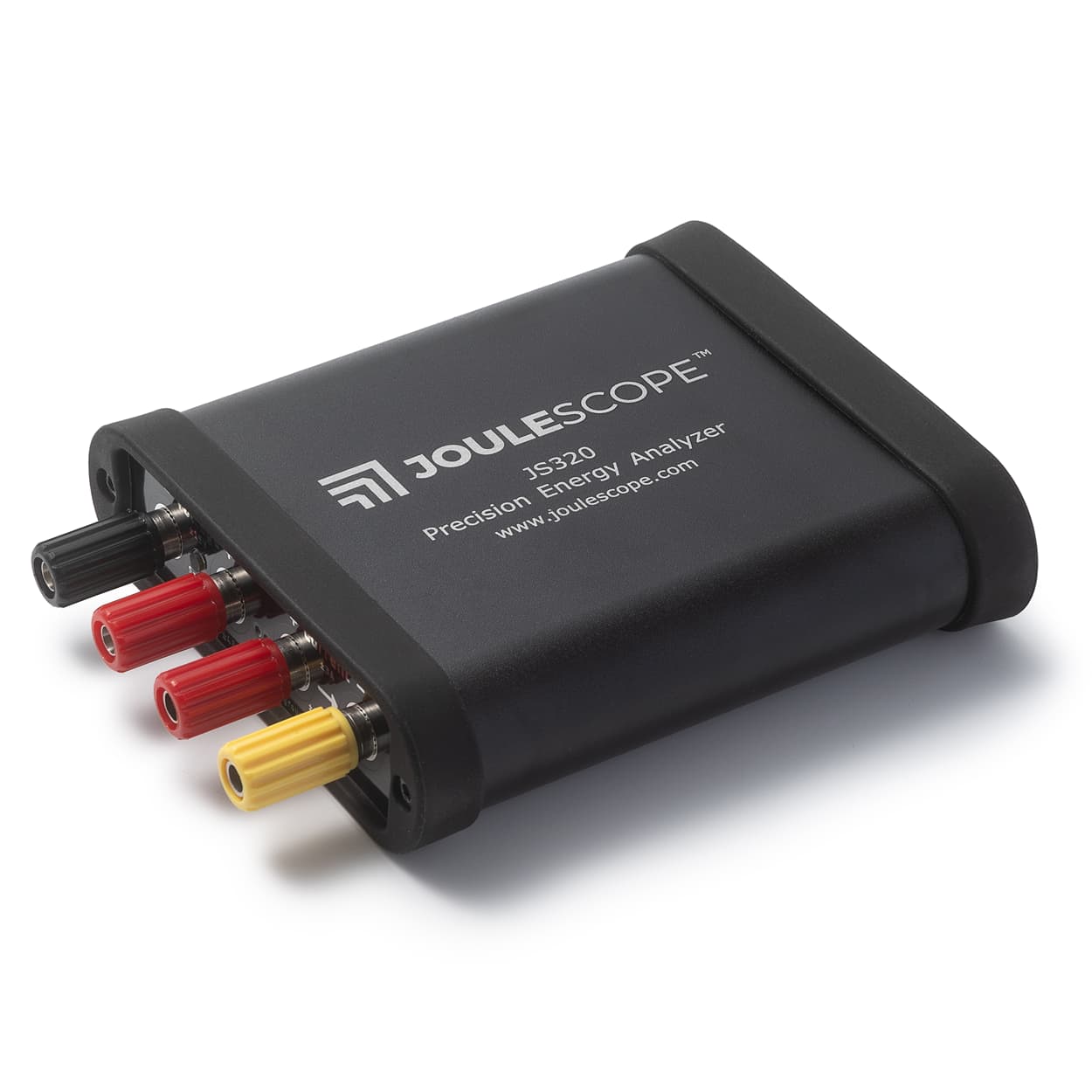
The Joulescope JS320 is our third-generation Joulescope product. It builds on the success of the original JS110 and the second-generation JS220, while focusing on one primary goal: improving measurement accuracy for low-current systems.
Many modern embedded systems spend most of their time in a very low-current sleep mode. BLE (Bluetooth) devices, backscatter RF systems, sensors, remote controls, energy-harvesting products, and battery-powered IoT devices often have sleep currents from tens of nanoamps to low microamps. They then briefly wake for higher-current activity. However, even active currents are dropping, and devices with active currents of 1 mA or less are becoming more common.
For these systems, small errors matter. Offset drift, leakage current, range-change behavior, ADC resolution, and digital processing precision can all affect the final energy measurement. The JS320 was redesigned to reduce these errors and improve confidence when measuring devices with low average current and low maximum current.
The JS320 improves on the JS220 in several important ways:
- Offset stability
- Enwavify™ v2 technology
- 24-bit ADC with wider digital path
- Linear phase analog path
- Additional improvements
Let's take a closer look at each of these improvements.
Offset stability
We redesigned the JS320 analog path from scratch with a focus on offset stability and low-current accuracy. We applied lessons learned from the limited-edition JS220+ to reduce leakage current, improve offset behavior, and increase long-term low-current stability.
The result is nanoamp-level stability over a day, with significantly improved offset behavior across all current ranges. In low-current Joulescope measurements, offset error often matters more than scale error, especially when measuring small currents relative to the selected range, as happens during underranging.
For JS220 users measuring very low-power systems, improved offset stability is one of the most important reasons to consider upgrading. The JS220 remains a capable instrument, but the JS320 is designed to reduce the specific errors that dominate low-current, long-duration measurements.
Enwavify™ v2 technology
The JS220 introduced Enwavify™, which allows Joulescopes to measure through current range changes. This technology remains one of Joulescope’s key advantages, especially compared with instruments that miss samples during current range changes.
However, during current-range changes, the JS220 measures with the accuracy of its 10 A range. The 10 A range is used for only about 10 microseconds at each current-range change, but for systems with low maximum current, the accumulated error from these brief intervals can still affect the accuracy of total charge and energy.
The JS320 adds hardware for Enwavify™ v2. While the JS220 Enwavify™ v1 was fixed to the 10 A range, the JS320's Enwavify™ v2 can measure using any current range during current range changes.
When you set current range limits, the JS320's measurement error during range changes is bounded by the least-sensitive enabled current range’s error, not the 10 A range’s error. In addition, the JS320 continues to measure using the same range when underranging to more sensitive ranges.
We also plan to introduce both manual and dynamic learning dual-step overranging. The JS220 always jumps to the least-sensitive current range during an overrange event. The JS320 hardware enables more flexible behavior.
We are still refining the algorithms to achieve the best accuracy across a wide range of real devices. Future firmware updates will deliver these algorithms. JS320 customers can benefit from Enwavify™ v2 today, with additional accuracy improvements delivered later through free firmware updates.
24-bit ADC with wider digital path
The JS320 uses a 24-bit ADC with 18 effective number of bits (ENOB), compared to the JS220's 16-bit ADC with 15 ENOB. This enhancement ensures that the analog path, rather than the ADC quantization, limits measurement performance.
We also widened the internal digital processing path. The JS220 and JS220+ use a 36-bit internal FPGA data path with approximately 0.9 nA quantization. The JS320 expands to a 64-bit digital path with 22 fA quantization.
The JS320's internal digital processing is no longer a practical limitation on measurement accuracy. The digital path now provides ample numerical precision beyond the JS320's analog measurement requirements.
Linear phase analog path
The JS220 uses a 6th-order Butterworth analog anti-aliasing filter. Butterworth filters are a good general-purpose choice because they provide a fast response, a flat passband, and a relatively sharp cutoff. However, they can produce overshoot on fast current steps.
For Joulescope users, this overshoot can make it harder to accurately interpret peak current. It can also complicate power supply sizing when the measured peak appears larger than the actual current transient.
The JS320 uses a 2nd-order maximally flat Bessel filter. Bessel filters have a more linear phase response and better time-domain behavior, with greatly reduced step-response overshoot. The tradeoff is a more gradual frequency response than Butterworth filters.
The JS320 manages this by using a delta-sigma (ΔΣ) ADC rather than a SAR ADC. The ΔΣ ADC uses a sinc4 digital filter, which dramatically reduces the need for sharp analog anti-aliasing filters.
The practical result is that the JS320 provides a cleaner time-domain response. At the stated bandwidth, fast current transitions are easier to interpret, and measured peaks better represent the actual signal behavior.
Additional improvements
While the JS320 looks similar to the JS220, we completely reworked the internal design. Along with major accuracy improvements, the JS320 includes many smaller changes that improve reliability, robustness, and measurement confidence:
Reliability and robustness
- Extended USB VBUS operating range down to 4.5 V, compared to 4.75 V for JS220
- Reduced power consumption for lower self-heating
- Improved FPGA firmware update reliability
- Improved handling of error conditions and host communication issues
- Doubled USB buffer sizes
Accuracy and synchronization
- Improved factory calibration accuracy
- Significantly reduced leakage currents on the voltage terminals
- Improved clock accuracy by 5x for better multi-instrument synchronization
Conclusion
The Joulescope JS320 is more than just a higher-spec JS220. It is a redesigned instrument focused on improving the measurements that matter most for modern low-power embedded systems.
If your device spends most of its time in sleep, wakes briefly, and has a maximum current in the milliamp range or below, the JS320 can provide better offset stability, better range-change accuracy, and improved time-domain behavior.
The JS220 remains an excellent instrument, especially for many general-purpose measurements. We will continue to support it for years to come. For engineers working on today’s lowest-power systems, the JS320 provides better low-current accuracy while preserving the simplicity and ease of use expected from Joulescopes.
Share:
Pricing changes for Jan 2022
Look Inside the JS320